
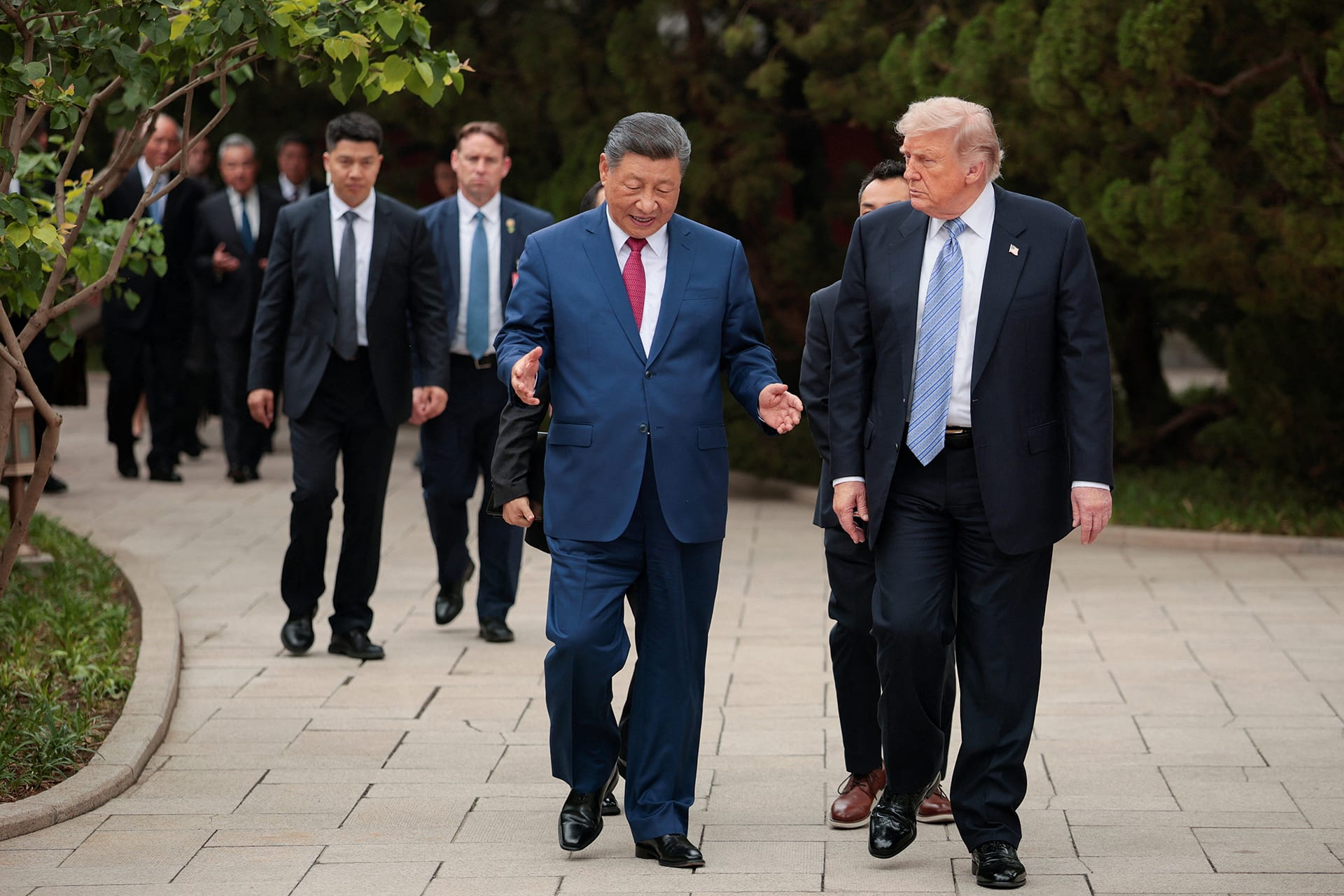
President Trump concluded a high-stakes visit to Beijing for a summit with Chinese President Xi Jinping. The trip, originally delayed by six weeks due to the U.S.-Israeli war against Iran launched on February 28, took place against a backdrop of sagging domestic approval ratings for Trump. Despite the grand pageantry of the welcome, the “stalemate summit” concluded with no major foreign policy or economic breakthroughs, leaving Trump empty-handed as he returned to Washington.
The crisis in the Middle East heavily dominated the agenda, but yielded little progress. The U.S. sought to pressure Beijing into using its leverage over Iran to reopen the Strait of Hormuz and push for peace negotiations. Instead, China remained non-committal, pointing back to its own previously released four-point peace proposal. While Trump claimed he wasn’t “asking for favors” and expected China to pressure Tehran automatically, he did note he was considering lifting sanctions on Chinese companies purchasing Iranian oil.
Tensions peaked over the issue of Taiwan, which Beijing labeled the most important and volatile issue in U.S.-China relations, warning that improper handling could spark direct military conflict. President Xi issued a notably stern, scripted warning regarding the self-governing island. In response, Trump remained largely quiet while on Chinese soil but later revealed he is weighing whether to indefinitely postpone a record $14 billion U.S.-Taiwan arms package, a move that would satisfy a major Chinese demand but potentially compromise U.S. military deterrence.
On trade and economic issues, the White House was unable to secure a comprehensive deal to permanently restore normal trade relations before the current tariff truce expires in November. While Trump touted “fantastic trade deals”—specifically claiming China agreed to buy 200 Boeing jets with the potential to expand to 750—the Chinese government did not officially confirm the orders. Furthermore, the U.S. failed to secure a concrete agreement regarding the supply chains of critical rare earth minerals, which China had restricted the previous year.
The summit also underscored a shifting geopolitical dynamic, with analysts noting that China successfully interacted with the U.S. as a peer superpower. While Trump was uncharacteristically conciliatory, praising Xi as a “great leader,” Xi adopted a more confrontational stance, referencing a “once in a century transformation” in world affairs. Following the trip, Trump defended himself on social media, claiming Xi’s apparent remarks about the United States being a “declining nation” were actually directed at the damage caused by the previous Biden administration.
Key Takeaways from the Summit
-
No Breakthrough on Iran: The U.S. failed to secure tangible Chinese assistance to pressure Iran into reopening the Strait of Hormuz or entering peace talks, though Trump signaled a potential lifting of sanctions on Chinese oil buyers.
-
Taiwan Warnings: President Xi issued a stern warning that the Taiwan issue could spark direct conflict, while Trump admitted he is reconsidering a scheduled $14 billion U.S. arms package to the island.
-
Unconfirmed Business Deals: Trump boasted of major U.S. aircraft sales to China, claiming an order of 200 Boeing jets that could reach 750, though Beijing did not formally confirm the agreement.
-
Stalled Trade & Rare Earths: No comprehensive agreement was reached to permanently end the tariff war before the November truce expiration, and the U.S. failed to secure a deal lifting China’s export restrictions on critical rare earth minerals.
-
A Peer Superpower Dynamic: Analysts noted the summit established a new equilibrium, elevating China’s status; Trump adopted an unusually conciliatory tone while Chinese officials viewed the administration’s posture as a sign of waning American dominance.
-
Reciprocal Visit Scheduled: Despite the lack of immediate concrete policy achievements, the two leaders maintained diplomatic ties by scheduling a reciprocal visit for President Xi to travel to the U.S. around late September.
